var wpbm_global1 = {"wpbm_ajaxurl":"https://the-travellist.com/wp-admin/admin-ajax.php","wpbm_plugin_url":"https://the-travellist.com/wp-content/plugins/booking-manager","wpbm_today":"[2026,11,12,16,21]","wpbm_plugin_filename":"index.php","message_verif_requred":"This field is required","message_verif_requred_for_check_box":"This checkbox must be checked","message_verif_requred_for_radio_box":"At least one option must be selected","message_verif_emeil":"Incorrect email address","message_verif_same_emeil":"Your emails do not match","wpbm_active_locale":"en_US","wpbm_message_processing":"Processing","wpbm_message_deleting":"Deleting","wpbm_message_updating":"Updating","wpbm_message_saving":"Saving"};
//# sourceURL=wpbm-global-vars-js-extra
function loadScript(a){var b=document.getElementsByTagName("head")[0],c=document.createElement("script");c.type="text/javascript",c.src="https://tracker.metricool.com/resources/be.js",c.onreadystatechange=a,c.onload=a,b.appendChild(c)}loadScript(function(){beTracker.t({hash:"77d6b1dab2de87fade951e8435e57335"})});
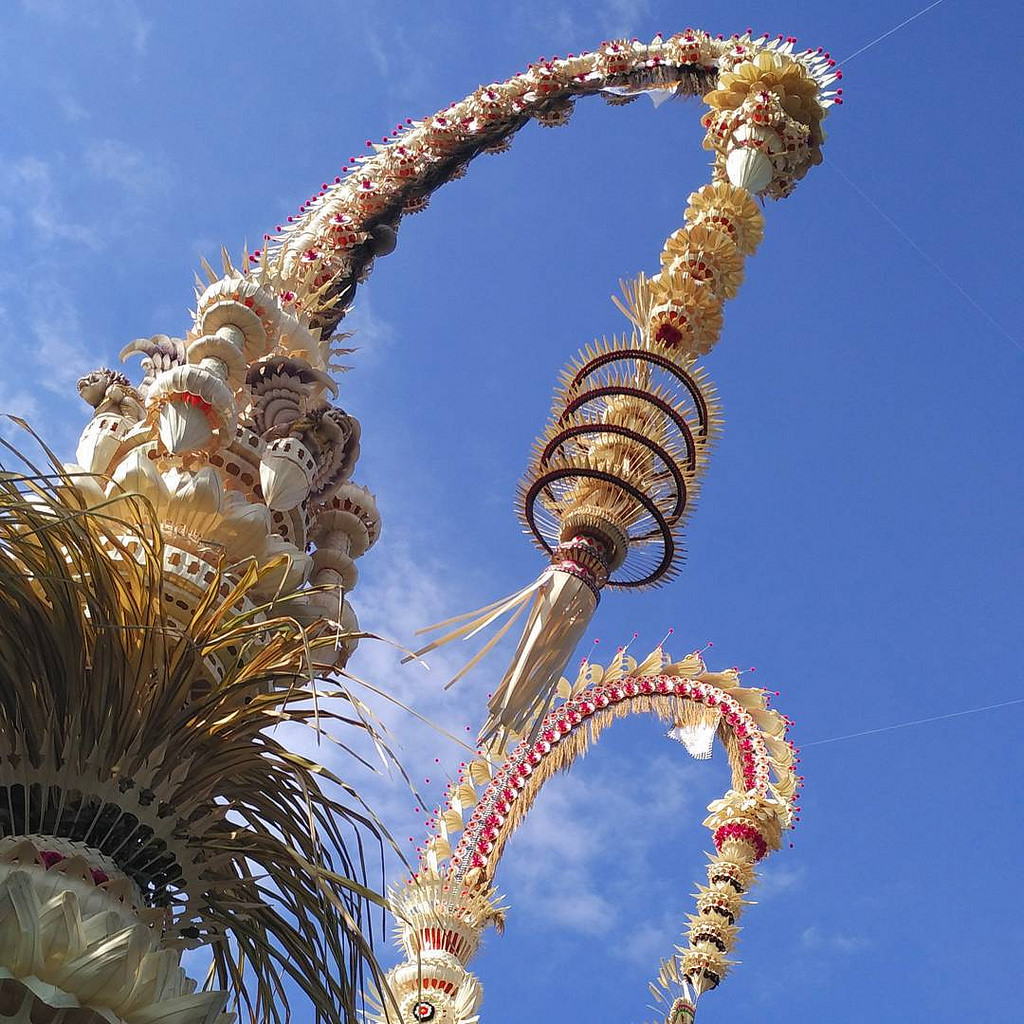
Penjor are one of the most visually striking expressions of Balinese spirituality — tall bamboo poles adorned with offerings that transform entire streets into sacred corridors. In Bali, the island of the gods, daily life is infused with rituals, symbolism, and deep spiritual meaning. One of the most visually striking elements you’ll find adorning the streets and homes during festive times—particularly around the Galungan celebration—is the Penjor. These tall, curved bamboo poles, beautifully decorated with coconut leaves, rice, and flowers, are not only decorative but also deeply symbolic.
Understanding this tradition means understanding the Balinese relationship between the home and the divine. The pole is not decoration in any secular sense — it is a direct communication between the household and the cosmic forces that Balinese Hinduism recognises as shaping daily life. The penjor is not made once and stored; it is made fresh for each ceremony, with new bamboo and new offerings, because the act of making it is itself a form of devotion. Putting up a penjor without the correct understanding of its meaning is considered inappropriate by most Balinese families, which is why the tradition is passed carefully from generation to generation within each household.
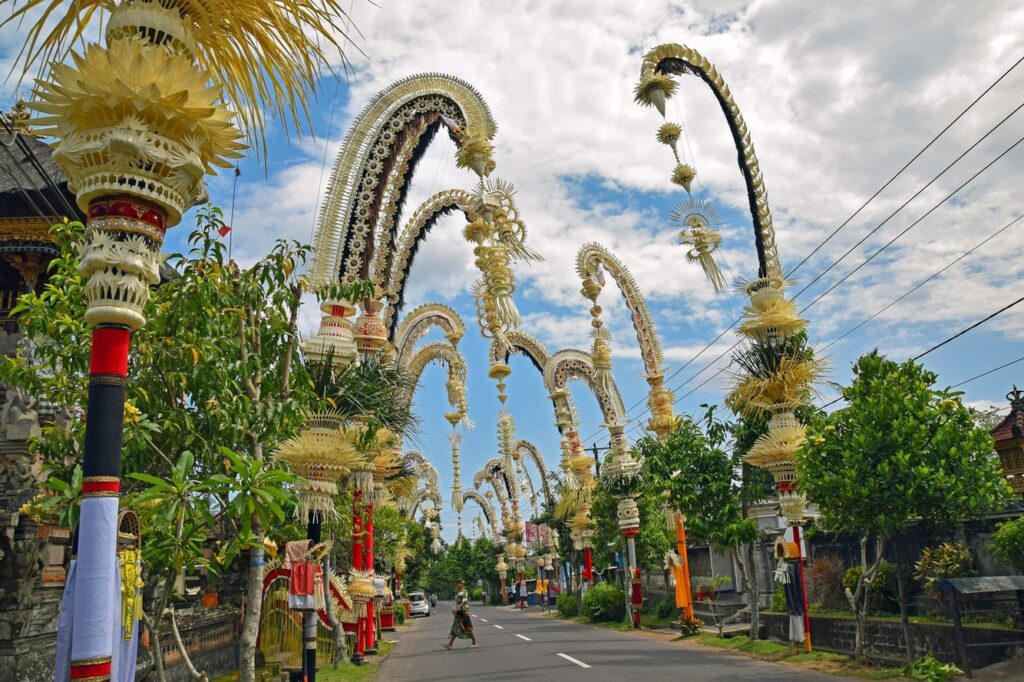
For visitors who see these bamboo poles lining the roads of Bali during Galungan, the visual effect is extraordinary. Thousands of tall, curving poles bending along a village road, each one slightly different in its ornamental details — the collective impression is of an island that has dressed itself for celebration in the deepest possible sense. Taking a scooter ride through the villages of east or north Bali during Galungan is one of the most memorable things you can do on the island. Learn more about Galungan on Wikipedia and explore our guide to Saraswati Day in Bali for more ceremonial context.
The materials used to construct a penjor are not chosen arbitrarily. Bamboo is selected for its height, strength, and symbolic associations with growth and aspiration. The decorative elements — woven coconut leaves, fruits, rice, and small offerings — are chosen to represent abundance, gratitude, and the fertility of the earth. In some families, the specific arrangement of these elements is governed by a household tradition that has been maintained for generations. In others, a pemangku (temple priest) is consulted to ensure the construction adheres to the correct spiritual specifications for the ceremony at hand.
Photographing the penjor is entirely acceptable, and visitors who ask permission before entering a family compound to photograph the ceremony around one are almost always welcomed warmly. The Balinese are proud of this tradition and generally happy to explain its significance to respectful visitors. If you encounter a penjor being erected, watching the process quietly from a distance is one of the most authentic and unhurried experiences Bali offers. There is no ticket, no tour guide, and no schedule — just a family going about an ancient practice in the same way their grandparents did.
When the penjor comes down after the ceremony period ends, the process is as deliberate as the construction. The offerings are removed and returned to the earth; the bamboo is repurposed or composted. Nothing is wasted. This circular approach — from the sourcing of raw materials to the careful dismantling of the finished structure — reflects the broader Balinese principle that all things exist in relationship, and that human actions carry consequences for the spiritual and natural world equally.
What is a Penjor?
A Penjor is a tall, gracefully arching bamboo pole adorned with offerings and symbols of prosperity. Erected in front of homes, temples, and along roadsides, they serve as an offering to the gods, particularly Dewa Dharma (the god of righteousness), and a gesture of gratitude for nature’s abundance.
Every part of a Penjor carries spiritual meaning. The bamboo pole represents Mount Agung, the sacred mountain and axis of the Balinese cosmos. The arching shape symbolises the tail of the Barong, a protective spirit. The decorations—such as pala bungkah (tubers), pala gantung (fruits), and janur (young coconut leaves)—symbolise fertility, prosperity, and the blessings of the earth.
When and Why Penjor are Used
The most common time to see Penjor is during Galungan, a major Balinese Hindu festival that celebrates the victory of dharma (good) over adharma (evil). They are erected a few days before the festival and remain standing until after Kuningan, which falls ten days later. However, some families may keep them up longer as a continued sign of devotion.
Beyond Galungan, they may also be erected for temple anniversaries (odalan), ceremonies at home, or even weddings, always reflecting the same sense of reverence and gratitude.
Penjor at Home: A Personal Offering
When placed in front of a home, a Penjor becomes a deeply personal offering. It marks the house as a place of spiritual significance, honouring both the ancestors and the gods. The base of the Penjor often includes a small shrine called a sanggah cucuk, where daily offerings are placed throughout the festival period.
In villages, walking through the narrow streets lined with Penjor is like stepping into a living artwork, with each one reflecting the creativity and devotion of the family who crafted it.
The Penjor is more than just a decorative feature; it is a symbol of balance, beauty, and devotion in Balinese culture. It bridges the human and divine, the material and spiritual. Visiting Bali during Galungan offers the unique opportunity to witness the grace of Penjor lining the roads and the heartfelt spirit behind them. Whether you’re exploring temples or staying in a Balinese home, the Penjor serves as a powerful reminder of the island’s sacred traditions.
window.maspikGuardConfig = {"honeypot":true,"honeypotName":"full-name-maspik-hp","honeypotLabel":"Leave this field empty","advancedKey":true,"keyName":"maspik_spam_key","keyValue":"pUoDQrdRACqDR6uCLikaghWVQswqp9OuNEIKXYrWWBg8ZzxuVgpekzV0ikVD7NUo","atomicHpId":"maspik_atomic_hp","atomicKeyId":"maspik_atomic_sk","atomicSignalsId":"maspik_atomic_sg","signals":true,"signalsName":"maspik_signals","signalsVersion":1,"signalsProbes":false,"skipSelector":""};
//# sourceURL=maspik-guard-js-before
var elementorFrontendConfig = {"environmentMode":{"edit":false,"wpPreview":false,"isScriptDebug":false},"i18n":{"shareOnFacebook":"Share on Facebook","shareOnX":"Share on X","pinIt":"Pin it","download":"Download","downloadImage":"Download image","fullscreen":"Fullscreen","zoom":"Zoom","share":"Share","playVideo":"Play Video","previous":"Previous","next":"Next","close":"Close","a11yCarouselPrevSlideMessage":"Previous slide","a11yCarouselNextSlideMessage":"Next slide","a11yCarouselFirstSlideMessage":"This is the first slide","a11yCarouselLastSlideMessage":"This is the last slide","a11yCarouselPaginationBulletMessage":"Go to slide"},"is_rtl":false,"breakpoints":{"xs":0,"sm":480,"md":768,"lg":1025,"xl":1440,"xxl":1600},"responsive":{"breakpoints":{"mobile":{"label":"Mobile Portrait","value":767,"default_value":767,"direction":"max","is_enabled":true},"mobile_extra":{"label":"Mobile Landscape","value":880,"default_value":880,"direction":"max","is_enabled":false},"tablet":{"label":"Tablet Portrait","value":1024,"default_value":1024,"direction":"max","is_enabled":true},"tablet_extra":{"label":"Tablet Landscape","value":1200,"default_value":1200,"direction":"max","is_enabled":false},"laptop":{"label":"Laptop","value":1366,"default_value":1366,"direction":"max","is_enabled":false},"widescreen":{"label":"Widescreen","value":2400,"default_value":2400,"direction":"min","is_enabled":false}},"hasCustomBreakpoints":false},"version":"4.3.6","is_static":false,"experimentalFeatures":{"additional_custom_breakpoints":true,"container":true,"theme_builder_v2":true,"hello-theme-header-footer":true,"nested-elements":true,"import-export-customization":true,"e_pro_atomic_form":true,"e_pro_collection_loop":true},"urls":{"assets":"https:\/\/the-travellist.com\/wp-content\/plugins\/elementor\/assets\/","ajaxurl":"https:\/\/the-travellist.com\/wp-admin\/admin-ajax.php","uploadUrl":"https:\/\/the-travellist.com\/wp-content\/uploads"},"nonces":{"floatingButtonsClickTracking":"5ca7fd2e30","atomicFormsSendForm":"7fe643a1f3"},"swiperClass":"swiper","settings":{"page":[],"editorPreferences":[]},"kit":{"body_background_background":"classic","active_breakpoints":["viewport_mobile","viewport_tablet"],"global_image_lightbox":"yes","lightbox_enable_counter":"yes","lightbox_enable_fullscreen":"yes","lightbox_enable_zoom":"yes","lightbox_enable_share":"yes","lightbox_title_src":"title","lightbox_description_src":"description","hello_header_logo_type":"logo","hello_header_menu_layout":"horizontal","hello_footer_logo_type":"logo"},"post":{"id":8400,"title":"Penjor%20in%20Balinese%20Homes%3A%20A%20Sacred%20Offering%20and%20Living%20Tradition","excerpt":"Penjor is a tall, gracefully arching bamboo pole adorned with offerings and symbols of prosperity","featuredImage":"https:\/\/the-travellist.com\/wp-content\/uploads\/penjor-hiasi-jalanan-untuk-sambut-kedatangan-delegasi-g20_43-1024x765.jpeg"}};
//# sourceURL=elementor-frontend-js-before
(function(){
"use strict";
function wpbc_init__head(){_wpbc.set_other_param( 'locale_active', 'en_US' ); _wpbc.set_other_param('time_gmt_arr', [2026,11,12,8,21] ); _wpbc.set_other_param('time_local_arr', [2026,11,12,16,21] ); _wpbc.set_other_param( 'today_arr', [2026,11,12,16,21] ); _wpbc.set_other_param( 'availability__unavailable_from_today', '0' ); _wpbc.set_other_param( 'url_plugin', 'https://the-travellist.com/wp-content/plugins/booking' ); _wpbc.set_other_param( 'this_page_booking_hash', '' ); _wpbc.set_other_param( 'calendars__on_this_page', [] ); _wpbc.set_other_param( 'calendars__first_day', '1' ); _wpbc.set_other_param( 'calendars__max_monthes_in_calendar', '2y' ); _wpbc.set_other_param( 'availability__week_days_unavailable', [999] ); _wpbc.set_other_param( 'calendars__days_select_mode', 'dynamic' ); _wpbc.set_other_param( 'calendars__fixed__days_num', 1 ); _wpbc.set_other_param( 'calendars__fixed__week_days__start', [-1] ); _wpbc.set_other_param( 'calendars__dynamic__days_min', 1 ); _wpbc.set_other_param( 'calendars__dynamic__days_max', 300 ); _wpbc.set_other_param( 'calendars__dynamic__days_specific', [] ); _wpbc.set_other_param( 'calendars__dynamic__week_days__start', [-1] ); _wpbc.set_other_param( 'calendars__days_selection__middle_days_opacity', '0.75' ); _wpbc.set_other_param( 'is_enabled_booking_recurrent_time', true ); _wpbc.set_other_param( 'is_allow_several_months_on_mobile', false ); _wpbc.set_other_param( 'is_enabled_change_over', false ); _wpbc.set_other_param( 'is_enabled_booking_timeslot_picker', true ); _wpbc.set_other_param( 'update', '12.0' ); _wpbc.set_other_param( 'version', 'biz_s' ); _wpbc.set_message( "message_check_no_selected_dates", "Please, select booking date(s) at Calendar." ); _wpbc.set_message( "message_range_selection_click_last_date", "Start date selected. Now click the last day of your booking to complete the date range." ); _wpbc.set_message( "message_range_selection_has_unavailable_dates", "The selected date range includes unavailable or already booked dates, so the selection was cleared. Please choose a range that contains only available dates." ); _wpbc.set_message( "message_dates_times_unavailable", "These dates and times in this calendar are already booked or unavailable." ); _wpbc.set_message( "message_choose_alternative_dates", "Please choose alternative date(s), times, or adjust the number of slots booked." ); _wpbc.set_message( "message_cannot_save_in_one_resource", "It is not possible to store this sequence of the dates into the one same resource." ); _wpbc.set_message( "message_check_required", "This field is required" ); _wpbc.set_message( "message_check_required_for_check_box", "This checkbox must be checked" ); _wpbc.set_message( "message_check_required_for_radio_box", "At least one option must be selected" ); _wpbc.set_message( "message_check_email", "Incorrect email address" ); _wpbc.set_message( "message_check_same_email", "Your emails do not match" ); _wpbc.set_message( "message_check_valid_date", "This field must be a valid date like {date_example}" ); _wpbc.set_message( "message_check_digits_only", "This field must contain only digits" ); _wpbc.set_message( "message_check_digits_count", "This field must contain {digits} digits" ); _wpbc.set_message( "message_error_start_time", "Start Time is invalid. The date or time may be booked, or already in the past! Please choose another date or time." ); _wpbc.set_message( "message_error_end_time", "End Time is invalid. The date or time may be booked, or already in the past. The End Time may also be earlier that the start time, if only 1 day was selected! Please choose another date or time." ); _wpbc.set_message( "message_error_range_time", "The time(s) may be booked, or already in the past!" ); _wpbc.set_message( "message_error_duration_time", "The time(s) may be booked, or already in the past!" ); _wpbc.set_message( "message_booking_saving", "Saving" ); _wpbc.set_message( "message_duplicate_booking_resource_on_page", "More than one calendar or booking form for Booking Resource ID {resource_id} is present on this page. A hidden copy still conflicts with the visible form and can prevent booking submission. The site administrator must keep only one calendar or form for this Booking Resource. After the page is corrected, reload it and try again." ); _wpbc.set_message( "message_booking_form_context_required", "This booking form is not connected to a valid calendar for Booking Resource ID {resource_id}. This can happen when the same Booking Resource is used more than once on the page, including in hidden content, or when the page cache is outdated. Reload the page and try again. If the problem continues, ask the site administrator to remove duplicate forms for this Booking Resource and clear the page cache." ); _wpbc.set_message( "message_booking_form_context_expired", "This booking form was generated by an older or cached version of the page for Booking Resource ID {resource_id}. Reload the page and try again. If the problem continues, ask the site administrator to clear the page cache and remove any duplicate calendar or form for this Booking Resource." ); _wpbc.set_message( "message_unexpected_server_response", "The server returned an unexpected response. Please reload the page and try again. If the problem continues, contact the website administrator." ); _wpbc.set_message( "message_http_conflict_cache_hint", "A cached or optimized version of this page may be outdated. Clear the browser cache and reload the page. Website administrators should also purge page, server, and CDN caches and regenerate minified or optimized files." ); _wpbc.set_message( "message_resource_selector_summary_label", "Booking Resource" ); _wpbc.set_message( "message_resource_selector_start_over", "Start over" ); _wpbc.set_message( "message_appointment_summary_label", "Your appointment" ); _wpbc.set_message( "message_appointment_start_over", "Start over" ); _wpbc.set_message( "message_captcha_incorrect", "The code you entered is incorrect" ); _wpbc.set_message( 'message_processing', "Processing" ); _wpbc.set_message( 'message_deleting', "Deleting" ); _wpbc.set_message( 'message_updating', "Updating" ); _wpbc.set_message( 'message_saving', "Saving" ); _wpbc.set_message( 'message_inline_preview_submission_disabled', "This is a request-local preview. Booking submission is disabled, and no booking will be created." ); _wpbc.set_message( 'message_error_check_in_out_time', "Error! Please reset your check-in\/check-out dates above." ); console.log( '== WPBC VARS 12.0 | 11.6.1 [biz_s] LOADED ==' );}
(function(){
if (window.__wpbc_boot_done__ === true) return;
var started = false;
function run_once(){
if (started || window.__wpbc_boot_done__ === true) return true;
started = true;
try { wpbc_init__head(); window.__wpbc_boot_done__ = true; }
catch(e){ started = false; try{console.error("WPBC init failed:", e);}catch(_){} }
return (window.__wpbc_boot_done__ === true);
}
function is_ready(){ return !!(window._wpbc && typeof window._wpbc.set_other_param === "function"); }
if ( is_ready() && run_once() ) return;
var waited = 0, max_ms = 10000, step = 50;
var timer = setInterval(function(){
if ( is_ready() && run_once() ) { clearInterval(timer); return; }
waited += step;
if ( waited >= max_ms ) {
clearInterval(timer);
// Switch to slow polling (1s) so we still init even without user interaction later.
var slow = setInterval(function(){ if ( is_ready() && run_once() ) clearInterval(slow); }, 1000);
try{console.warn("WPBC: _wpbc not detected within " + max_ms + "ms; using slow polling.");}catch(_){}
}
}, step);
var evs = ["wpbc-ready","wpbc:ready","wpbc_ready","wpbcReady"];
evs.forEach(function(name){
document.addEventListener(name, function onready(){ if (is_ready() && run_once()) document.removeEventListener(name, onready); });
});
if (document.readyState === "loading") {
document.addEventListener("DOMContentLoaded", function(){ if (is_ready()) run_once(); }, { once:true });
}
window.addEventListener("load", function(){ if (is_ready()) run_once(); }, { once:true });
window.addEventListener("pageshow", function(){ if (is_ready()) run_once(); }, { once:true });
document.addEventListener("visibilitychange", function(){ if (!document.hidden && is_ready()) run_once(); });
var ui = ["click","mousemove","touchstart","keydown","scroll"];
var ui_bailed = false;
function on_ui(){ if (ui_bailed) return; if (is_ready() && run_once()){ ui_bailed = true; ui.forEach(function(t){ document.removeEventListener(t, on_ui, true); }); } }
ui.forEach(function(t){ document.addEventListener(t, on_ui, true); });
})();
})();
//# sourceURL=wpbc_all-js-after
var wpbc_booking_appointment_config = {"ajax_url":"https://the-travellist.com/wp-admin/admin-ajax.php","action":"WPBC_AJX_BOOKING_APPOINTMENT_RESOLVE","validate_action":"WPBC_AJX_BOOKING_APPOINTMENT_VALIDATE_TIME","nonce":"349e017e77","error":"The Appointment form could not be loaded. Please try again.","validation_error":"This Appointment time could not be verified. Please try again.","initialization_error":"The Appointment form could not be initialized. Please start over and try again.","duplicate_provider":"This Provider already has an open Appointment form on this page. Complete or restart that Appointment before opening another form for the same Provider.","service_found":"Service found.","services_found":"Services found.","provider_found":"Provider found.","providers_found":"Providers found."};
//# sourceURL=wpbc-booking-appointment-js-extra
var wpbc_booking_resource_selector_config = {"ajax_url":"https://the-travellist.com/wp-admin/admin-ajax.php","action":"WPBC_AJX_BOOKING_RESOURCE_SELECTOR_RESOLVE","nonce":"4cf2cd180e","error":"The booking form could not be loaded. Please try again.","initialization_error":"The booking form could not be initialized. Please start over and try again.","duplicate_resource":"This Booking Resource already has an open booking form on this page. Complete or restart that booking before opening another form for the same resource.","resource_found":"Booking Resource found.","resources_found":"Booking Resources found."};
//# sourceURL=wpbc-booking-resource-selector-js-extra