var wpbm_global1 = {"wpbm_ajaxurl":"https://the-travellist.com/wp-admin/admin-ajax.php","wpbm_plugin_url":"https://the-travellist.com/wp-content/plugins/booking-manager","wpbm_today":"[2026,11,12,16,30]","wpbm_plugin_filename":"index.php","message_verif_requred":"This field is required","message_verif_requred_for_check_box":"This checkbox must be checked","message_verif_requred_for_radio_box":"At least one option must be selected","message_verif_emeil":"Incorrect email address","message_verif_same_emeil":"Your emails do not match","wpbm_active_locale":"en_US","wpbm_message_processing":"Processing","wpbm_message_deleting":"Deleting","wpbm_message_updating":"Updating","wpbm_message_saving":"Saving"};
//# sourceURL=wpbm-global-vars-js-extra
function loadScript(a){var b=document.getElementsByTagName("head")[0],c=document.createElement("script");c.type="text/javascript",c.src="https://tracker.metricool.com/resources/be.js",c.onreadystatechange=a,c.onload=a,b.appendChild(c)}loadScript(function(){beTracker.t({hash:"77d6b1dab2de87fade951e8435e57335"})});
Balinese daily offerings are not a peripheral aspect of island life — they are central to it. The practice of placing canang sari each morning is so deeply embedded in Balinese culture that it functions less like a religious obligation and more like breathing: automatic, constant, and sustaining. For the Balinese, a day without making offerings would feel fundamentally incomplete. The act of offering is itself the prayer; the physical preparation of the canang is the meditation; and the placement of it at the threshold of the home, the temple, and the workplace is the daily renewal of a covenant between the human and the divine.
The components of Balinese daily offerings are carefully selected for their symbolic meaning. The square base (raka) represents the four directions and the earth. The flowers placed within it — always fresh, always arranged with intention — represent the qualities of the divine: white for Iswara in the east, red for Brahma in the south, yellow for Mahadeva in the west, and blue or green for Wisnu in the north. A stick of incense carries the offering upward. The entire construction, which takes an experienced maker only a few minutes, encodes a complete cosmological statement in perishable natural materials.
Visitors to Bali who observe Balinese daily offerings being placed are witnessing one of the most unself-conscious spiritual acts in the world. The women making and placing offerings are rarely performing for an audience; they are engaged in a private but communal practice that happens simultaneously across the island at the same time each morning. Respectful observation from a distance — without photographing people without permission and without stepping over or on offerings placed on the ground — is the appropriate way to engage with this beautiful tradition.
Balinese Daily Offerings play a vital role in expressing gratitude and devotion, not through words but through offerings of natural items arranged with care. This tradition aligns with Krishna’s message in the Bhagavad Gita 9.26: “If one offers to Me with devotion a leaf, a flower, a fruit, or even water, I delightfully partake of that item offered with love by My devotee in pure consciousness.” – Krishna tells Arjuna what God expect and requires of an offering.
It is all about expressing gratitude, not with words, but with crafted trays filled with flowers and burning incents. Offerings in Bali are always made of natural things and object they use in everyday life. Most offerings contain just what Krishna specified – leaves, flowers, fruit, and holly water.
The simplest daily offerings are normally done by housewives upon the completion of their cooking by putting little rice, salt, and side dishes according to whatever they cook for the day on little cuts of banana leaf. These offerings are called banten saiban, and normally are placed on five different parts representing The Panca Maha Bhuta; on the ground, on the well, on the stove or fireplace, on the roof, and on the family temple. Another form of this offering can be seen in much simpler action such as putting aside a small amount of food before they start eating the serving on the plate. Or, pouring a few drops of their first cup of coffee or tea on the ground before they drink any themselves.
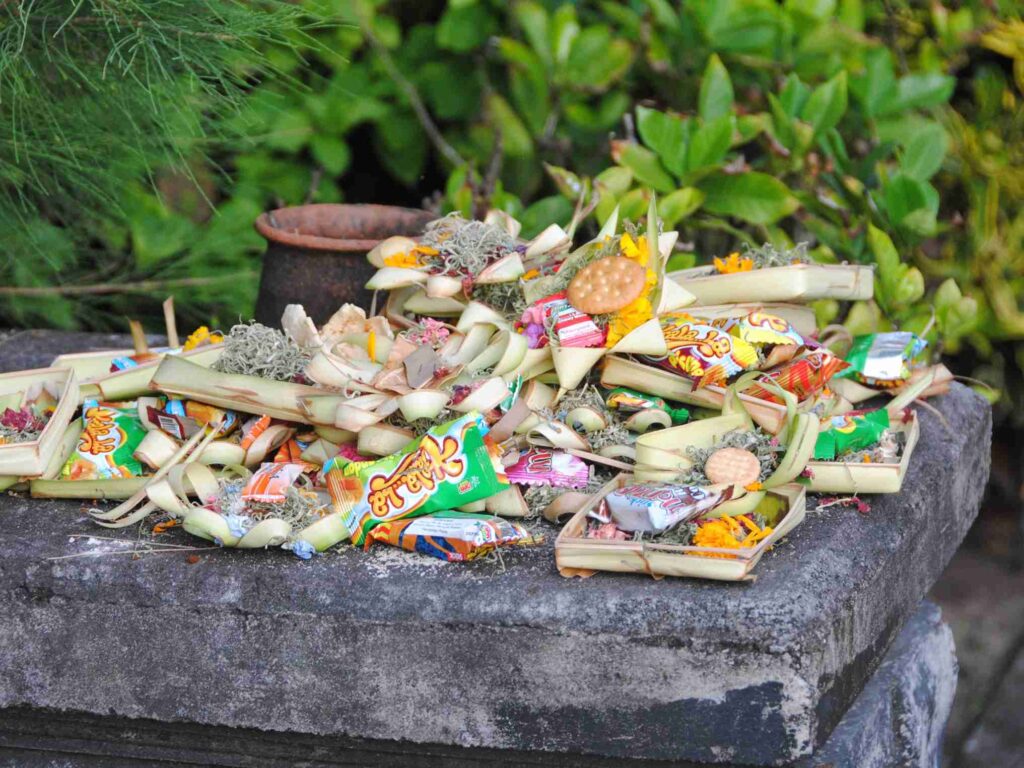
The second degree in complexity of daily offerings is in the form of canang sari. It is a little tray made of coconut leaves filled with flowers of various color and some green shredded pandanus leaves – sometimes with a burning incents on it. Nothing placed randomly, canang sari is deliberately crafted and is filled with meaningful objects. Every piece in the arrangement is selected for what it symbolizes. The Hindu’s Trimurti or Trinity of Brahma, Wisnu, Siwa is represented by the piece called porosan which contained gambir (uncaria) and pinang (areca nut), betel leaf, and white lime – sticked together in the form of a mini parcel.
Flower petals symbolize peace and sincerity are strategically chosen and precisely placed; white flowers facing to the East are symbols of Iswara, red flowers facing to the South are symbols of Brahma, Yellow flowers facing to the West are symbols of Mahadeva, and blue or green flowers facing to the North are symbols of Vishnu.
In some regions in Bali, we may see some old Chinese coins, or regular coins, or paper money placed as a redeemer for all the shortcomings that may exist. And some food items; cookies, crackers, or candies placed alongside the canang sari to demonstrate selflessness. Everything should be as edible as possible so that stray dogs, monkeys or other animals could also eat it.
A dash of perfumed oil completes the canang’s preparation. The next step is the sari to be wafted to God, often by lighting an incent for the smoke to carry the essence of the offering upwards. Out of respects for the Gods, Balinese wear sarong and sash whenever doing prayers and presenting the offerings. On the next day a fresh offering will come and the previous one can be removed. Hinduism is very concerned with the relationship between humanity and the environment. Whatever comes from nature, it has to be back to nature. Learn more about Canang sari on Wikipedia.
Balinese daily offerings are also a reminder that devotion does not require grandeur. The canang sari is small — it can be held in one hand — and it is made from materials that cost almost nothing. Yet it is placed with full attention and genuine intention, which is precisely what gives it its spiritual weight. In a culture saturated with elaborate temple ceremonies and large-scale community rituals, the daily offering practice grounds spiritual life in the domestic and the personal. Every household, regardless of social standing, participates equally in the practice of Balinese daily offerings.
The relationship between Balinese daily offerings and the island’s broader ecology is worth noting. The materials used — banana leaves, coconut palm, flowers, incense — are all plant-based and biodegradable. Once an offering has been accepted (recognised by the gods and returned to the earth), it is left to decompose naturally. This means that Balinese daily offerings contribute zero lasting waste to the environment, a remarkable characteristic for a practice that produces millions of individual offerings across the island every single day.
Understanding Balinese daily offerings also helps visitors make sense of what they encounter on the streets and in shops, restaurants, and guesthouses across the island. The small leaf squares placed at thresholds, at the base of trees, on motorbike seats, and at business entrances are all versions of canang sari. They are not clutter or discarded items; they are intentional acts of gratitude and spiritual maintenance placed at points of spiritual significance. Recognising them as such transforms the visual landscape of Bali from something exotic into something legible and deeply considered.
The practice of making Balinese daily offerings is also an art form in its own right. Master offering-makers can fold and weave palm leaves into intricate three-dimensional structures in minutes, each one a small work of precise craft. Younger women learn by watching and then by doing, beginning with the simplest forms and gradually acquiring the speed and dexterity that comes only from daily repetition. This transmission of skill — from older women to younger ones, mostly without formal instruction but through presence and imitation — is one of the most important forms of cultural education on the island, and it happens entirely outside the formal school system.
Visitors who want to engage more deeply with Balinese daily offerings can seek out offering-making classes, which are offered at many cultural centres and family compounds across the island, particularly in Ubud and Sanur. A two-hour session with a local teacher is typically affordable and provides a level of insight into the practice that no amount of observation from the outside can match. Learning to make even a simple canang sari instils an understanding of the care and intention involved that permanently changes how you see the offerings placed throughout the island’s streets and doorways.
The seasonal variation in Balinese daily offerings is also worth understanding. On ordinary days, the offerings are modest and consistent. On ceremonially significant days — Kliwon, Kajeng, Purnama, Tilem — the offerings become more elaborate and the ritual surrounding their placement more involved. During Galungan and Kuningan, the island-wide transformation of Balinese daily offerings into towering fruit towers (gebogan) and roadside penjor creates one of the most visually extraordinary experiences in Southeast Asia. Knowing this rhythm helps visitors understand why the offerings they encounter differ in scale and complexity from one day to the next.
<< If you liked this article, you may also like our other articles >> To chat with our marketing partner about your business, please contact The Travellist
window.maspikGuardConfig = {"honeypot":true,"honeypotName":"full-name-maspik-hp","honeypotLabel":"Leave this field empty","advancedKey":true,"keyName":"maspik_spam_key","keyValue":"pUoDQrdRACqDR6uCLikaghWVQswqp9OuNEIKXYrWWBg8ZzxuVgpekzV0ikVD7NUo","atomicHpId":"maspik_atomic_hp","atomicKeyId":"maspik_atomic_sk","atomicSignalsId":"maspik_atomic_sg","signals":true,"signalsName":"maspik_signals","signalsVersion":1,"signalsProbes":false,"skipSelector":""};
//# sourceURL=maspik-guard-js-before
var elementorFrontendConfig = {"environmentMode":{"edit":false,"wpPreview":false,"isScriptDebug":false},"i18n":{"shareOnFacebook":"Share on Facebook","shareOnX":"Share on X","pinIt":"Pin it","download":"Download","downloadImage":"Download image","fullscreen":"Fullscreen","zoom":"Zoom","share":"Share","playVideo":"Play Video","previous":"Previous","next":"Next","close":"Close","a11yCarouselPrevSlideMessage":"Previous slide","a11yCarouselNextSlideMessage":"Next slide","a11yCarouselFirstSlideMessage":"This is the first slide","a11yCarouselLastSlideMessage":"This is the last slide","a11yCarouselPaginationBulletMessage":"Go to slide"},"is_rtl":false,"breakpoints":{"xs":0,"sm":480,"md":768,"lg":1025,"xl":1440,"xxl":1600},"responsive":{"breakpoints":{"mobile":{"label":"Mobile Portrait","value":767,"default_value":767,"direction":"max","is_enabled":true},"mobile_extra":{"label":"Mobile Landscape","value":880,"default_value":880,"direction":"max","is_enabled":false},"tablet":{"label":"Tablet Portrait","value":1024,"default_value":1024,"direction":"max","is_enabled":true},"tablet_extra":{"label":"Tablet Landscape","value":1200,"default_value":1200,"direction":"max","is_enabled":false},"laptop":{"label":"Laptop","value":1366,"default_value":1366,"direction":"max","is_enabled":false},"widescreen":{"label":"Widescreen","value":2400,"default_value":2400,"direction":"min","is_enabled":false}},"hasCustomBreakpoints":false},"version":"4.3.6","is_static":false,"experimentalFeatures":{"additional_custom_breakpoints":true,"container":true,"theme_builder_v2":true,"hello-theme-header-footer":true,"nested-elements":true,"import-export-customization":true,"e_pro_atomic_form":true,"e_pro_collection_loop":true},"urls":{"assets":"https:\/\/the-travellist.com\/wp-content\/plugins\/elementor\/assets\/","ajaxurl":"https:\/\/the-travellist.com\/wp-admin\/admin-ajax.php","uploadUrl":"https:\/\/the-travellist.com\/wp-content\/uploads"},"nonces":{"floatingButtonsClickTracking":"5ca7fd2e30","atomicFormsSendForm":"7fe643a1f3"},"swiperClass":"swiper","settings":{"page":[],"editorPreferences":[]},"kit":{"body_background_background":"classic","active_breakpoints":["viewport_mobile","viewport_tablet"],"global_image_lightbox":"yes","lightbox_enable_counter":"yes","lightbox_enable_fullscreen":"yes","lightbox_enable_zoom":"yes","lightbox_enable_share":"yes","lightbox_title_src":"title","lightbox_description_src":"description","hello_header_logo_type":"logo","hello_header_menu_layout":"horizontal","hello_footer_logo_type":"logo"},"post":{"id":4200,"title":"Balinese%20Daily%20Offerings%3A%20A%20Guide%20to%20the%20Sacred%20Tradition%20of%20Canang%20Sari","excerpt":"It is all about expressing gratitude, not with words, but with crafted trays filled with flowers and burning incents.","featuredImage":"https:\/\/the-travellist.com\/wp-content\/uploads\/2023\/12\/offering1.jpg"}};
//# sourceURL=elementor-frontend-js-before
(function(){
"use strict";
function wpbc_init__head(){_wpbc.set_other_param( 'locale_active', 'en_US' ); _wpbc.set_other_param('time_gmt_arr', [2026,11,12,8,30] ); _wpbc.set_other_param('time_local_arr', [2026,11,12,16,30] ); _wpbc.set_other_param( 'today_arr', [2026,11,12,16,30] ); _wpbc.set_other_param( 'availability__unavailable_from_today', '0' ); _wpbc.set_other_param( 'url_plugin', 'https://the-travellist.com/wp-content/plugins/booking' ); _wpbc.set_other_param( 'this_page_booking_hash', '' ); _wpbc.set_other_param( 'calendars__on_this_page', [] ); _wpbc.set_other_param( 'calendars__first_day', '1' ); _wpbc.set_other_param( 'calendars__max_monthes_in_calendar', '2y' ); _wpbc.set_other_param( 'availability__week_days_unavailable', [999] ); _wpbc.set_other_param( 'calendars__days_select_mode', 'dynamic' ); _wpbc.set_other_param( 'calendars__fixed__days_num', 1 ); _wpbc.set_other_param( 'calendars__fixed__week_days__start', [-1] ); _wpbc.set_other_param( 'calendars__dynamic__days_min', 1 ); _wpbc.set_other_param( 'calendars__dynamic__days_max', 300 ); _wpbc.set_other_param( 'calendars__dynamic__days_specific', [] ); _wpbc.set_other_param( 'calendars__dynamic__week_days__start', [-1] ); _wpbc.set_other_param( 'calendars__days_selection__middle_days_opacity', '0.75' ); _wpbc.set_other_param( 'is_enabled_booking_recurrent_time', true ); _wpbc.set_other_param( 'is_allow_several_months_on_mobile', false ); _wpbc.set_other_param( 'is_enabled_change_over', false ); _wpbc.set_other_param( 'is_enabled_booking_timeslot_picker', true ); _wpbc.set_other_param( 'update', '12.0' ); _wpbc.set_other_param( 'version', 'biz_s' ); _wpbc.set_message( "message_check_no_selected_dates", "Please, select booking date(s) at Calendar." ); _wpbc.set_message( "message_range_selection_click_last_date", "Start date selected. Now click the last day of your booking to complete the date range." ); _wpbc.set_message( "message_range_selection_has_unavailable_dates", "The selected date range includes unavailable or already booked dates, so the selection was cleared. Please choose a range that contains only available dates." ); _wpbc.set_message( "message_dates_times_unavailable", "These dates and times in this calendar are already booked or unavailable." ); _wpbc.set_message( "message_choose_alternative_dates", "Please choose alternative date(s), times, or adjust the number of slots booked." ); _wpbc.set_message( "message_cannot_save_in_one_resource", "It is not possible to store this sequence of the dates into the one same resource." ); _wpbc.set_message( "message_check_required", "This field is required" ); _wpbc.set_message( "message_check_required_for_check_box", "This checkbox must be checked" ); _wpbc.set_message( "message_check_required_for_radio_box", "At least one option must be selected" ); _wpbc.set_message( "message_check_email", "Incorrect email address" ); _wpbc.set_message( "message_check_same_email", "Your emails do not match" ); _wpbc.set_message( "message_check_valid_date", "This field must be a valid date like {date_example}" ); _wpbc.set_message( "message_check_digits_only", "This field must contain only digits" ); _wpbc.set_message( "message_check_digits_count", "This field must contain {digits} digits" ); _wpbc.set_message( "message_error_start_time", "Start Time is invalid. The date or time may be booked, or already in the past! Please choose another date or time." ); _wpbc.set_message( "message_error_end_time", "End Time is invalid. The date or time may be booked, or already in the past. The End Time may also be earlier that the start time, if only 1 day was selected! Please choose another date or time." ); _wpbc.set_message( "message_error_range_time", "The time(s) may be booked, or already in the past!" ); _wpbc.set_message( "message_error_duration_time", "The time(s) may be booked, or already in the past!" ); _wpbc.set_message( "message_booking_saving", "Saving" ); _wpbc.set_message( "message_duplicate_booking_resource_on_page", "More than one calendar or booking form for Booking Resource ID {resource_id} is present on this page. A hidden copy still conflicts with the visible form and can prevent booking submission. The site administrator must keep only one calendar or form for this Booking Resource. After the page is corrected, reload it and try again." ); _wpbc.set_message( "message_booking_form_context_required", "This booking form is not connected to a valid calendar for Booking Resource ID {resource_id}. This can happen when the same Booking Resource is used more than once on the page, including in hidden content, or when the page cache is outdated. Reload the page and try again. If the problem continues, ask the site administrator to remove duplicate forms for this Booking Resource and clear the page cache." ); _wpbc.set_message( "message_booking_form_context_expired", "This booking form was generated by an older or cached version of the page for Booking Resource ID {resource_id}. Reload the page and try again. If the problem continues, ask the site administrator to clear the page cache and remove any duplicate calendar or form for this Booking Resource." ); _wpbc.set_message( "message_unexpected_server_response", "The server returned an unexpected response. Please reload the page and try again. If the problem continues, contact the website administrator." ); _wpbc.set_message( "message_http_conflict_cache_hint", "A cached or optimized version of this page may be outdated. Clear the browser cache and reload the page. Website administrators should also purge page, server, and CDN caches and regenerate minified or optimized files." ); _wpbc.set_message( "message_resource_selector_summary_label", "Booking Resource" ); _wpbc.set_message( "message_resource_selector_start_over", "Start over" ); _wpbc.set_message( "message_appointment_summary_label", "Your appointment" ); _wpbc.set_message( "message_appointment_start_over", "Start over" ); _wpbc.set_message( "message_captcha_incorrect", "The code you entered is incorrect" ); _wpbc.set_message( 'message_processing', "Processing" ); _wpbc.set_message( 'message_deleting', "Deleting" ); _wpbc.set_message( 'message_updating', "Updating" ); _wpbc.set_message( 'message_saving', "Saving" ); _wpbc.set_message( 'message_inline_preview_submission_disabled', "This is a request-local preview. Booking submission is disabled, and no booking will be created." ); _wpbc.set_message( 'message_error_check_in_out_time', "Error! Please reset your check-in\/check-out dates above." ); console.log( '== WPBC VARS 12.0 | 11.6.1 [biz_s] LOADED ==' );}
(function(){
if (window.__wpbc_boot_done__ === true) return;
var started = false;
function run_once(){
if (started || window.__wpbc_boot_done__ === true) return true;
started = true;
try { wpbc_init__head(); window.__wpbc_boot_done__ = true; }
catch(e){ started = false; try{console.error("WPBC init failed:", e);}catch(_){} }
return (window.__wpbc_boot_done__ === true);
}
function is_ready(){ return !!(window._wpbc && typeof window._wpbc.set_other_param === "function"); }
if ( is_ready() && run_once() ) return;
var waited = 0, max_ms = 10000, step = 50;
var timer = setInterval(function(){
if ( is_ready() && run_once() ) { clearInterval(timer); return; }
waited += step;
if ( waited >= max_ms ) {
clearInterval(timer);
// Switch to slow polling (1s) so we still init even without user interaction later.
var slow = setInterval(function(){ if ( is_ready() && run_once() ) clearInterval(slow); }, 1000);
try{console.warn("WPBC: _wpbc not detected within " + max_ms + "ms; using slow polling.");}catch(_){}
}
}, step);
var evs = ["wpbc-ready","wpbc:ready","wpbc_ready","wpbcReady"];
evs.forEach(function(name){
document.addEventListener(name, function onready(){ if (is_ready() && run_once()) document.removeEventListener(name, onready); });
});
if (document.readyState === "loading") {
document.addEventListener("DOMContentLoaded", function(){ if (is_ready()) run_once(); }, { once:true });
}
window.addEventListener("load", function(){ if (is_ready()) run_once(); }, { once:true });
window.addEventListener("pageshow", function(){ if (is_ready()) run_once(); }, { once:true });
document.addEventListener("visibilitychange", function(){ if (!document.hidden && is_ready()) run_once(); });
var ui = ["click","mousemove","touchstart","keydown","scroll"];
var ui_bailed = false;
function on_ui(){ if (ui_bailed) return; if (is_ready() && run_once()){ ui_bailed = true; ui.forEach(function(t){ document.removeEventListener(t, on_ui, true); }); } }
ui.forEach(function(t){ document.addEventListener(t, on_ui, true); });
})();
})();
//# sourceURL=wpbc_all-js-after
var wpbc_booking_appointment_config = {"ajax_url":"https://the-travellist.com/wp-admin/admin-ajax.php","action":"WPBC_AJX_BOOKING_APPOINTMENT_RESOLVE","validate_action":"WPBC_AJX_BOOKING_APPOINTMENT_VALIDATE_TIME","nonce":"349e017e77","error":"The Appointment form could not be loaded. Please try again.","validation_error":"This Appointment time could not be verified. Please try again.","initialization_error":"The Appointment form could not be initialized. Please start over and try again.","duplicate_provider":"This Provider already has an open Appointment form on this page. Complete or restart that Appointment before opening another form for the same Provider.","service_found":"Service found.","services_found":"Services found.","provider_found":"Provider found.","providers_found":"Providers found."};
//# sourceURL=wpbc-booking-appointment-js-extra
var wpbc_booking_resource_selector_config = {"ajax_url":"https://the-travellist.com/wp-admin/admin-ajax.php","action":"WPBC_AJX_BOOKING_RESOURCE_SELECTOR_RESOLVE","nonce":"4cf2cd180e","error":"The booking form could not be loaded. Please try again.","initialization_error":"The booking form could not be initialized. Please start over and try again.","duplicate_resource":"This Booking Resource already has an open booking form on this page. Complete or restart that booking before opening another form for the same resource.","resource_found":"Booking Resource found.","resources_found":"Booking Resources found."};
//# sourceURL=wpbc-booking-resource-selector-js-extra